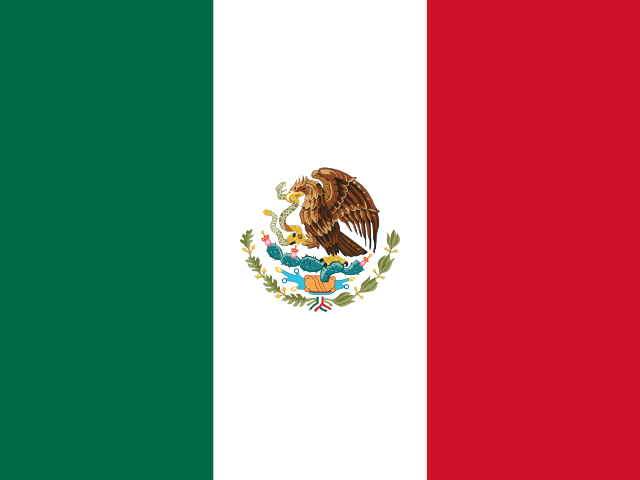
Mexico
A solid all-round choice. Ranked 31 of 55, strongest on affordability, softest on safety.
- Healthcare 78
- Retiree visa 50
- Affordability 95
- Safety 28
- Climate 84
- Expat community 78
- Retirement visaYesTemporary Resident Visa via economic solvency (the income route retirees use), which leads to Permanent Resident status.mexperience.com
- Min incomeHigh (harder to meet)mexperience.com
- Monthly budgetMuch lower than the USnumbeo.com
- HealthcareGoodallianzcare.com
- SafetyUse cautionen.wikipedia.org
- Top citiesMérida, Ajijic (Lake Chapala), Puerto Vallarta
Good to know
- Good healthcare accessPublic IMSS covers legal residents but has long non-emergency waits and Spanish-only administration; private hospitals in big cities are high quality.allianzcare.com
- Dedicated retirement visaTemporary Resident Visa via economic solvency (the income route retirees use), which leads to Permanent Resident status.mexperience.com
- Low cost of livingEstimated single-person costs about Mex$12,521 per month (roughly US$650) excluding rent.numbeo.com
- Comfortable climateArid or semiarid north, tropical south; highlands between 1,000-2,000m stay mild (16-20C) year-round, with a June to mid-October rainy season.en.wikipedia.org
- Established expat communityLargest US expat population abroad (around 900,000 US-born residents, 2017); retirees cluster in enclaves such as Ajijic and San Miguel de Allende where English is common.en.wikipedia.org
Watch out for
- Safety needs attentionGlobal Peace Index 2025 ranks Mexico 139th of 163 (score 2.65, low state of peace); safety varies sharply by region, with popular expat hubs generally calmer.en.wikipedia.org
Visa & residency
Temporary Resident Visa via economic solvency (the income route retirees use), which leads to Permanent Resident status.
About US$4,400 per month of regular income shown over the last 6 months (some consulates ask 12), or about US$74,000 in savings as an alternative.
You must qualify under either the income or the savings option, not both; Temporary Resident status is renewable and leads to Permanent Resident.
Healthcare
Public IMSS covers legal residents but has long non-emergency waits and Spanish-only administration; private hospitals in big cities are high quality.
International private health insurance is strongly recommended so expats can reach better facilities and avoid public-system waits and language barriers.
Cost of living
Estimated single-person costs about Mex$12,521 per month (roughly US$650) excluding rent.
A one-bedroom city-centre apartment averages about Mex$13,014 per month (roughly US$680), well below major US cities.
Safety
Global Peace Index 2025 ranks Mexico 139th of 163 (score 2.65, low state of peace); safety varies sharply by region, with popular expat hubs generally calmer.
Climate
Varied; the Tropic of Cancer splits tropical and temperate zones, with mild temperate highlands.
Arid or semiarid north, tropical south; highlands between 1,000-2,000m stay mild (16-20C) year-round, with a June to mid-October rainy season.
Community & language
Largest US expat population abroad (around 900,000 US-born residents, 2017); retirees cluster in enclaves such as Ajijic and San Miguel de Allende where English is common.
Spanish is the official language; 68 Indigenous languages hold co-official status.
Taxes
Residents are taxed on worldwide income, but foreign income tax paid can be credited against Mexican tax; verify pension treatment individually.
Mexico has double-tax treaties with the US, UK, Canada, Australia and the Netherlands.
Moving & migration
Foreign retirees need a temporary or permanent resident card (not a tourist FMM) and a Mexican tax ID (RFC) to open a bank account. Major expat-friendly banks include BBVA Mexico, Banorte, Citibanamex, and Santander. Some branches may open basic accounts with only a passport and FMM tourist card, but this is inconsistent. Physical presence is generally required. You will need: valid passport, residency card (or FMM), proof of address (utility bill or lease), and RFC (tax ID). Some banks like BBVA offer account opening via their app with Mexican ID documents. Requirements have tightened since 2022 under anti-money laundering regulations.
Public system (IMSS): Once you hold a temporary or permanent resident card, you can voluntarily enroll at your local IMSS office. Requirements: valid residency card, CURP (population registry code), proof of address, and completed application form. No waiting period after enrollment, but pre-existing conditions have a waiting period. Monthly premiums depend on age (approx. $5,000-$15,000 MXN/year for ages 50-80). Private healthcare is widely available and many expats use it instead or as a supplement; top hospitals include Hospital Angeles, Medica Sur, and Star Medica. The public INSABI system (now IMSS-Bienestar) provides free basic care to all residents regardless of immigration status, but quality and availability vary by region.
Foreign tourists can drive on their home license for the duration of their tourist permit (up to 180 days). An International Driving Permit (IDP) is recommended but not always required. Once you become a temporary or permanent resident, you must obtain a Mexican driver's license. The conversion process: take your valid foreign license, residency card, proof of address, and ID to the local Secretaria de Movilidad or Transito office. Some states require a written exam (in Spanish) and/or a practical driving test; others may issue a license directly if the foreign license is valid. No age restrictions beyond 18+ to drive. Licenses are state-issued and typically valid for 2-3 years for temporary residents, 5 years for permanent residents.
You can import household goods duty-free under the 'menaje de casa' (household goods) provision. Requirements: must be a temporary or permanent resident, import must occur within 6 months of your first entry with the residency visa. File Formato de Declaracion de Menaje de Casa at the Mexican consulate before shipping (or at customs upon arrival at certain ports). Required documents: detailed inventory list in Spanish (with values), valid passport, residency visa/card, bill of lading, and completed customs declaration. Prohibited items: food, plants, weapons, narcotics, and certain electronics. Used household goods are generally duty-free; new items may be taxed. Typical cost: shipping a 20ft container from North America is $3,000-$6,000 USD; from Europe $5,000-$10,000. Customs broker recommended.
Dogs and cats can enter Mexico with: (1) Health certificate issued by a licensed veterinarian within 15 days of travel, showing the animal is free of infectious diseases. (2) Proof of rabies vaccination, administered at least 30 days before travel if it's the first vaccination, and valid/not expired. (3) Upon arrival at the airport, a SENASICA officer inspects the animal. If all documents are in order, the pet is released immediately. No quarantine for dogs/cats from most countries. No mandatory microchip requirement for Mexico (unlike most countries). No breed restrictions at the federal level. If traveling with more than 3 pets, different rules apply. The inspection can be done at the airport animal health office (OISA).
Step-by-step: (1) Apply for Temporary Residence Visa at a Mexican consulate in your home country. Must prove economic solvency: approx. $65,000-$75,000 USD in savings/investments OR monthly income of ~$4,000-$4,500 USD over the last 6-12 months (amounts vary by consulate and exchange rate). Processing: 1-4 weeks. (2) Once approved, the visa sticker is placed in your passport. You have 180 days to enter Mexico. (3) Upon arrival in Mexico, you have 30 days to exchange ('canje') the visa for the actual Temporary Resident Card at the local INM office. Bring passport, visa, FMM form, proof of address, application form, and pay the fee (approx. $5,000 MXN). The card is issued the same day or within a few days. (4) Temporary Residence is granted for 1 year first, then renewable for 1, 2, or 3 more years (total 4 years max). Renewal requires proving you still meet economic solvency. (5) After 4 consecutive years of Temporary Residence, you can apply for Permanent Residence. No need to leave the country. (6) Permanent Residence has no expiry (though the card itself is renewed every 5-10 years, free of charge). Citizenship possible after 5 years of legal residence (2 years if married to a Mexican citizen), but requires Spanish proficiency and a history exam -- naturalization processing takes 1-2 years.
Popular retirement spots
Where retirees in Mexico tend to settle, and the honest reason why. Each note shows its source.
Mérida
Hot colonial capital of Yucatan with a large old town and an established English-speaking expat community.
Ajijic (Lake Chapala)
Village on Lake Chapala, Jalisco with a mild year-round climate and one of Mexico's largest American and Canadian retiree communities.
Puerto Vallarta
Pacific resort city in Jalisco with a tropical climate, a popular retirement destination for US and Canadian retirees.
Questions about retiring in Mexico
Answered from the verified data on this page. Every answer shows its source; anything we have not confirmed says so plainly rather than guessing.
- Does Mexico have a retirement visa?
Yes. Mexico offers the Temporary Resident Visa via economic solvency (the income route retirees use), which leads to Permanent Resident status..
mexperience.com- How much monthly income do I need to retire in Mexico?
As a guide: About US$4,400 per month of regular income shown over the last 6 months (some consulates ask 12), or about US$74,000 in savings as an alternative. Treat this as indicative and verify the current official figure before you rely on it.
mexperience.com- Is healthcare good for expats in Mexico?
Healthcare quality is rated good. Public IMSS covers legal residents but has long non-emergency waits and Spanish-only administration; private hospitals in big cities are high quality. On cost: International private health insurance is strongly recommended so expats can reach better facilities and avoid public-system waits and language barriers.
allianzcare.com- How expensive is it to retire in Mexico?
Much lower than the US. A comfortable single-retiree budget is Estimated single-person costs about Mex$12,521 per month (roughly US$650) excluding rent.
numbeo.com- Is Mexico safe?
Use caution. Global Peace Index 2025 ranks Mexico 139th of 163 (score 2.65, low state of peace); safety varies sharply by region, with popular expat hubs generally calmer.
en.wikipedia.org- What is the climate like in Mexico?
The climate is Varied; the Tropic of Cancer splits tropical and temperate zones, with mild temperate highlands.. Arid or semiarid north, tropical south; highlands between 1,000-2,000m stay mild (16-20C) year-round, with a June to mid-October rainy season.
en.wikipedia.org- Where do retirees live in Mexico?
Popular retirement spots include Mérida, Ajijic (Lake Chapala) and Puerto Vallarta.
en.wikipedia.org
Compare Mexico with its closest rivals
The three countries whose RetireScore sits nearest.