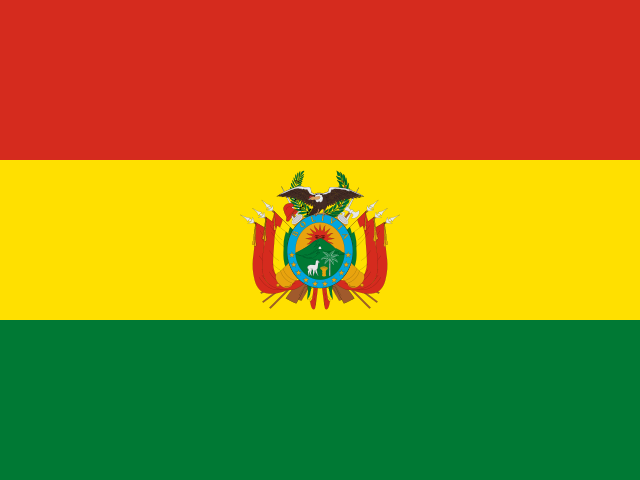
Bolivia
A mixed pick with real trade-offs. Ranked 50 of 55, strongest on affordability, softest on retiree visa.
- Healthcare 55
- Retiree visa 22
- Affordability 95
- Safety 52
- Climate 84
- Expat community not verified58
1 of 6 axes rest on data we could not verify yet; those score a neutral 50 and are marked "not verified".
- Retirement visaNogoresident.com
- Min incomeLow (easier to meet)goresident.com
- Monthly budgetMuch lower than the USsmartasset.com
- HealthcareFairjarniascyril.com
- SafetyModerateen.wikipedia.org
- Top citiesCochabamba, Sucre
Good to know
- Low cost of livingBasic necessary living expenses average about 49.7% lower than in the US, making a comfortable retirement budget achievable on a modest income.smartasset.com
- Comfortable climateClimate is dictated by altitude: the high Altiplano/Andes is cold (15-20C days, near-freezing nights), the mid-elevation valleys are mild year-round, and the eastern tropical lowlands are hot and humid, averaging around 30C.en.wikipedia.org
Watch out for
- No dedicated retirement visagoresident.com
- Safety needs attentionBolivia ranks 92nd of 163 countries in the Global Peace Index (score 2.054), placing it in the mid-tier for peacefulness.en.wikipedia.org
- Expat community data not verified yet
Visa & residency
No dedicated retirement visa; retirees and passive-income residents apply through the general Specific Purpose Visa (Visa de Objeto Determinado), which leads to temporary then permanent residency.
Commonly cited minimum solvency threshold is roughly USD 300 per month, shown via bank statements or pension documentation; higher amounts strengthen the application.
Bolivia has no segmented pensionado/rentista categories; all long-term residency runs through the flexible Specific Purpose Visa. Temporary residency (1-2 years, renewable) can convert to permanent, with naturalisation possible after 3 years of continuous legal residency (roughly 4-6 years end-to-end).
Healthcare
Three-tier system: a free public system (SUS), social security (CNS) and private providers. Public care struggles with overcrowding, drug shortages and ageing equipment, while private clinics in La Paz, Santa Cruz and Cochabamba offer good-quality care at 60-80% below US prices.
Private health insurance is strongly advised for expats; local private plans run about USD 30-100/month and international policies with evacuation cover about USD 80-400+/month.
Cost of living
Basic necessary living expenses average about 49.7% lower than in the US, making a comfortable retirement budget achievable on a modest income.
A one-bedroom apartment averages about USD 354/month in La Paz and USD 415/month in Santa Cruz; rents run roughly 73.6% below US levels (vs about USD 1,280 for a comparable unit in Phoenix, AZ).
Safety
Bolivia ranks 92nd of 163 countries in the Global Peace Index (score 2.054), placing it in the mid-tier for peacefulness.
Climate
highland (cold Altiplano and temperate eternal-spring valleys) plus hot tropical lowlands
Climate is dictated by altitude: the high Altiplano/Andes is cold (15-20C days, near-freezing nights), the mid-elevation valleys are mild year-round, and the eastern tropical lowlands are hot and humid, averaging around 30C.
Community & language
No verified data yet
Bolivia scores 521 on the EF English Proficiency Index (rank 49, moderate band), above the global average; still, Spanish is essential for daily life outside tourist and private-clinic settings.
Spanish is the predominant official language, alongside 36 recognised indigenous languages; the most widely spoken are Quechua, Aymara and Guarani.
Taxes
Bolivia taxes only Bolivian-source income (territorial system); no Bolivian tax is imposed on foreign-source income such as foreign pensions. The domestic personal income tax (RC-IVA) rate is 13%.
Bolivia has double-tax treaties with Andean Community members (Colombia, Ecuador, Peru) plus Argentina, France, Germany, Spain, Sweden and the United Kingdom.
Moving & migration
No verified data yet
No verified data yet
No verified data yet
No verified data yet
No verified data yet
1. Apply for a Specific Purpose Visa (Visa de Objeto Determinado) at a Bolivian consulate in your home country. No dedicated retirement visa exists; retirees and passive-income applicants use this general route. 2. Enter Bolivia and convert the visa to temporary residency (1-2 years, renewable) at the Direccion General de Migracion (DIGEMIG). 3. After holding temporary residency, apply for permanent residency, typically achievable after 3 years of continuous legal residency. 4. Naturalisation possible after 3 years of continuous legal residency in practice (roughly 4-6 years end-to-end).
Popular retirement spots
Where retirees in Bolivia tend to settle, and the honest reason why. Each note shows its source.
Cochabamba
A high-altitude Andean city at about 2,570 m known as the City of Eternal Spring for its mild year-round climate, and a major cultural and commercial hub of central Bolivia.
Sucre
Bolivia's constitutional capital and a UNESCO World Heritage Site with well-preserved colonial architecture, sitting at about 2,790 m with a cool subtropical highland climate.
Questions about retiring in Bolivia
Answered from the verified data on this page. Every answer shows its source; anything we have not confirmed says so plainly rather than guessing.
- Does Bolivia have a retirement visa?
No dedicated retirement visa. Retirement is handled through a general residence route: No dedicated retirement visa; retirees and passive-income residents apply through the general Specific Purpose Visa (Visa de Objeto Determinado), which leads to temporary then permanent residency..
goresident.com- How much monthly income do I need to retire in Bolivia?
As a guide: Commonly cited minimum solvency threshold is roughly USD 300 per month, shown via bank statements or pension documentation; higher amounts strengthen the application. Treat this as indicative and verify the current official figure before you rely on it.
goresident.com- Is healthcare good for expats in Bolivia?
Healthcare quality is rated fair. Three-tier system: a free public system (SUS), social security (CNS) and private providers. Public care struggles with overcrowding, drug shortages and ageing equipment, while private clinics in La Paz, Santa Cruz and Cochabamba offer good-quality care at 60-80% below US prices. On cost: Private health insurance is strongly advised for expats; local private plans run about USD 30-100/month and international policies with evacuation cover about USD 80-400+/month.
jarniascyril.com- How expensive is it to retire in Bolivia?
Much lower than the US. A comfortable single-retiree budget is Basic necessary living expenses average about 49.7% lower than in the US, making a comfortable retirement budget achievable on a modest income.
smartasset.com- Is Bolivia safe?
Moderate. Bolivia ranks 92nd of 163 countries in the Global Peace Index (score 2.054), placing it in the mid-tier for peacefulness.
en.wikipedia.org- What is the climate like in Bolivia?
The climate is highland (cold Altiplano and temperate eternal-spring valleys) plus hot tropical lowlands. Climate is dictated by altitude: the high Altiplano/Andes is cold (15-20C days, near-freezing nights), the mid-elevation valleys are mild year-round, and the eastern tropical lowlands are hot and humid, averaging around 30C.
en.wikipedia.org- Where do retirees live in Bolivia?
Popular retirement spots include Cochabamba and Sucre.
en.wikipedia.org
Compare Bolivia with its closest rivals
The three countries whose RetireScore sits nearest.