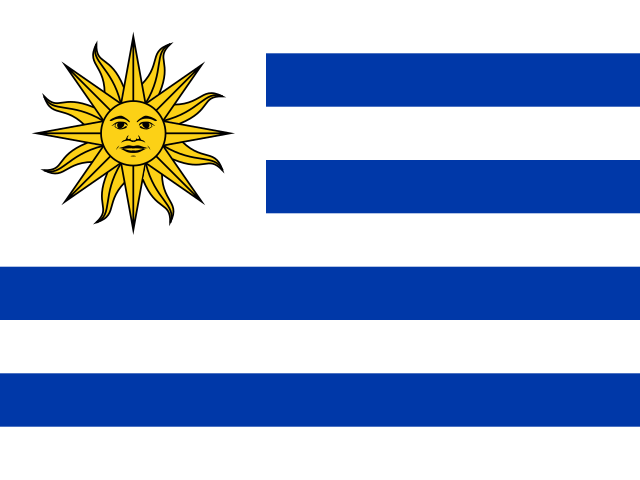
Uruguay
A standout retirement base. Ranked 7 of 55, strongest on retiree visa, softest on expat community.
- Healthcare 78
- Retiree visa 92
- Affordability 78
- Safety 76
- Climate 78
- Expat community 53
- Retirement visaYesResidency as Jubilado o Pensionista (pensioner) or Rentista (independent means), leading directly to permanent residency and a Cedula de Identidad.legalclarity.org
- Min incomeLow (easier to meet)legalclarity.org
- Monthly budget~$850-1,000/monumbeo.com
- HealthcareGoodlivinginuruguay.com
- SafetySafeen.wikipedia.org
- Top citiesMontevideo, Punta del Este, Colonia del Sacramento
Good to know
- Good healthcare accessUniversal system combining public ASSE hospitals with private non-profit mutualista cooperatives; well-trained doctors and internationally accredited facilities such as Hospital Britanico in Montevideo.livinginuruguay.com
- Dedicated retirement visaResidency as Jubilado o Pensionista (pensioner) or Rentista (independent means), leading directly to permanent residency and a Cedula de Identidad.legalclarity.org
- Low cost of livingSingle person around USD 850 to 1,000 per month excluding rent; cost of living including rent is about 52 percent lower than the US, though Uruguay is relatively expensive by Latin American standards.numbeo.com
- Safe for retireesUruguay ranks 43rd of 163 on the 2026 Global Peace Index with a score of 1.754, making it the most peaceful country in South America, ahead of Chile and Argentina.en.wikipedia.org
- Comfortable climateLocated entirely within the temperate zone with a fairly uniform humid subtropical climate; warm summers, mild to chilly damp winters, high humidity, and no temperature extremes.en.wikipedia.org
Watch out for
- Few expats, less EnglishThe expat community is smaller than in Costa Rica, Panama or Mexico, concentrated in Montevideo and Punta del Este. Uruguay scores 542 (High band, 34th globally) on the EF English Proficiency Index, but everyday English is limited and Spanish is essential outside expat and medical circles.ef.edu
Visa & residency
Residency as Jubilado o Pensionista (pensioner) or Rentista (independent means), leading directly to permanent residency and a Cedula de Identidad.
No legally fixed minimum, but authorities in practice expect roughly USD 1,500 per month of recurring income for a single applicant, with more required per dependent.
There is no age minimum and applicants need not be formally retired; income can come from pensions, Social Security, dividends or rental income from abroad. Both categories lead straight to permanent residency without a temporary phase.
Healthcare
Universal system combining public ASSE hospitals with private non-profit mutualista cooperatives; well-trained doctors and internationally accredited facilities such as Hospital Britanico in Montevideo.
Most expats join a private mutualista, paying roughly USD 100 to 250 per person per month (rising with age) plus small co-payments of about USD 5 to 20 per service.
Cost of living
Single person around USD 850 to 1,000 per month excluding rent; cost of living including rent is about 52 percent lower than the US, though Uruguay is relatively expensive by Latin American standards.
A one-bedroom apartment in a city centre typically rents for around UYU 26,000 per month (range UYU 20,000 to 40,000); US rents are about 152 percent higher than Uruguay.
Safety
Uruguay ranks 43rd of 163 on the 2026 Global Peace Index with a score of 1.754, making it the most peaceful country in South America, ahead of Chile and Argentina.
Climate
Located entirely within the temperate zone with a fairly uniform humid subtropical climate; warm summers, mild to chilly damp winters, high humidity, and no temperature extremes.
Community & language
The expat community is smaller than in Costa Rica, Panama or Mexico, concentrated in Montevideo and Punta del Este. Uruguay scores 542 (High band, 34th globally) on the EF English Proficiency Index, but everyday English is limited and Spanish is essential outside expat and medical circles.
Spanish (Rioplatense) is the official and predominant language; English proficiency is rated High but Spanish is essential for daily life outside expat circles.
Taxes
Uruguay uses a territorial system that generally does not tax foreign pension income, US Social Security or IRA/401(k) distributions. New residents can also elect a tax holiday on foreign-source income; a 2026 reform now taxes foreign investment income at 12 percent but keeps pensions and Social Security exempt.
The United States and Uruguay have no comprehensive income tax treaty, so Americans rely on the Foreign Earned Income Exclusion or Foreign Tax Credit to avoid double taxation.
Moving & migration
Foreign residents can open a bank account in Uruguay with a valid passport and proof of residency (residencia en tramite certificate or cedula de identidad). Most major banks (Banco Republica - BROU, Santander, Itau, BBVA, HSBC) serve foreigners. BROU (state bank) is the most expat-friendly and does not require a minimum deposit. Requirements typically include: passport, proof of address in Uruguay, proof of income/funds origin, and tax ID (RUT). Physical presence is generally required to open an account, though some banks may allow remote opening with a local representative.
Uruguay has a mixed public-private healthcare system. Upon obtaining residency (cedula), you are entitled to register with the public system (ASSE - Administracion de los Servicios de Salud del Estado) or the mutualista system (private non-profit health organizations). Registration requires: valid cedula de identidad, proof of address, and completed registration form. There is no waiting period once you hold a valid cedula. Many expat retirees choose a mutualista (such as Hospital Britanico, Medica Uruguaya, or CASMU) which requires a monthly fee (approx. $50-150 USD depending on age and coverage). Private health insurance is also available through companies like MP, Blue Cross, and SUMMUM.
Foreigners can drive in Uruguay with their home country license for 180 days from entry. After this period, or upon obtaining residency, you must obtain a Uruguayan driver's license (libreta de conducir). The process: present valid foreign license, passport, cedula de identidad, certificate of physical/mental fitness from an authorized medical provider, and pass a theoretical exam (in Spanish) at the Intendencia (municipal government). If your country has a license reciprocity agreement with Uruguay, the theoretical exam may be waived. You need a Certificado de Antecedentes Judiciales (criminal background check). Minimum age: 18 years for car license.
Uruguay allows duty-free import of used household goods and personal effects for foreigners establishing residence. Required documents: detailed inventory in Spanish (packing list with values), passport, certificate of residence or residency in process, bill of lading, and sworn declaration before Uruguayan customs. Goods must have been used for at least 6 months and be for personal use. The shipment should arrive within 180 days of your arrival. Motor vehicles can be imported duty-free once under the residency benefit (one vehicle per person, valued up to a certain threshold). Prohibited items include: firearms (without special permit), narcotics, agricultural products, and certain electronics.
Uruguay requires: ISO 11784/11785 microchip (15 digits), valid rabies vaccination certificate (administered at least 30 days and not more than 1 year before travel), international health certificate from an accredited veterinarian endorsed by the exporting country's government authority (must be issued within 10 days of travel). A rabies antibody titer test is not required for most countries. No quarantine for dogs and cats meeting all requirements. An import permit must be obtained before travel from the Ministry of Livestock, Agriculture and Fisheries (MGAP). Additional requirements: dogs must have proof of vaccination against distemper, hepatitis, leptospirosis, and parvovirus. No specific breed restrictions nationally.
Step 1 (Before arrival): Gather documents - birth certificate (apostilled), marriage certificate if applicable (apostilled), police clearance from country of origin (apostilled), proof of income (pension statements or bank statements showing monthly income of approximately $1,500 USD). Step 2 (Arrival): Enter Uruguay as a tourist. Apply for residencia en tramite (temporary residency initiation) at the Direccion Nacional de Migracion. Present all apostilled documents, passport, proof of address, and proof of income. Receive a provisional cedula within 1-2 weeks. Step 3: Complete medical examination at an authorized clinic. Step 4: After approximately 4-10 months, receive cedula de identidad (national ID for foreigners) and residencia temporaria (temporary residency valid 2 years). Step 5: After 2 years of temporary residency, apply for residencia permanente (permanent residency). Step 6: After 3 years of permanent residency (5 years total in Uruguay), eligible to apply for citizenship (naturalizacion).
Popular retirement spots
Where retirees in Uruguay tend to settle, and the honest reason why. Each note shows its source.
Montevideo
Uruguay's coastal capital on the Rio de la Plata, chosen for a mild climate and consistently the highest-rated quality of living in Latin America.
Punta del Este
An upscale Atlantic seaside resort city and peninsula, known for its beaches, first-class hotels and appeal to wealthy Latin American and North American residents.
Colonia del Sacramento
A historic Portuguese-founded town on the Rio de la Plata whose UNESCO-listed cobblestone quarter draws expats seeking a quiet colonial setting.
Questions about retiring in Uruguay
Answered from the verified data on this page. Every answer shows its source; anything we have not confirmed says so plainly rather than guessing.
- Does Uruguay have a retirement visa?
Yes. Uruguay offers the Residency as Jubilado o Pensionista (pensioner) or Rentista (independent means), leading directly to permanent residency and a Cedula de Identidad..
legalclarity.org- How much monthly income do I need to retire in Uruguay?
As a guide: No legally fixed minimum, but authorities in practice expect roughly USD 1,500 per month of recurring income for a single applicant, with more required per dependent. Treat this as indicative and verify the current official figure before you rely on it.
legalclarity.org- Is healthcare good for expats in Uruguay?
Healthcare quality is rated good. Universal system combining public ASSE hospitals with private non-profit mutualista cooperatives; well-trained doctors and internationally accredited facilities such as Hospital Britanico in Montevideo. On cost: Most expats join a private mutualista, paying roughly USD 100 to 250 per person per month (rising with age) plus small co-payments of about USD 5 to 20 per service.
livinginuruguay.com- How expensive is it to retire in Uruguay?
Lower than the US. A comfortable single-retiree budget is Single person around USD 850 to 1,000 per month excluding rent; cost of living including rent is about 52 percent lower than the US, though Uruguay is relatively expensive by Latin American standards.
numbeo.com- Is Uruguay safe?
Safe. Uruguay ranks 43rd of 163 on the 2026 Global Peace Index with a score of 1.754, making it the most peaceful country in South America, ahead of Chile and Argentina.
en.wikipedia.org- What is the climate like in Uruguay?
The climate is Humid subtropical (Koppen Cfa), temperate zone. Located entirely within the temperate zone with a fairly uniform humid subtropical climate; warm summers, mild to chilly damp winters, high humidity, and no temperature extremes.
en.wikipedia.org- Where do retirees live in Uruguay?
Popular retirement spots include Montevideo, Punta del Este and Colonia del Sacramento.
en.wikipedia.org
Compare Uruguay with its closest rivals
The three countries whose RetireScore sits nearest.