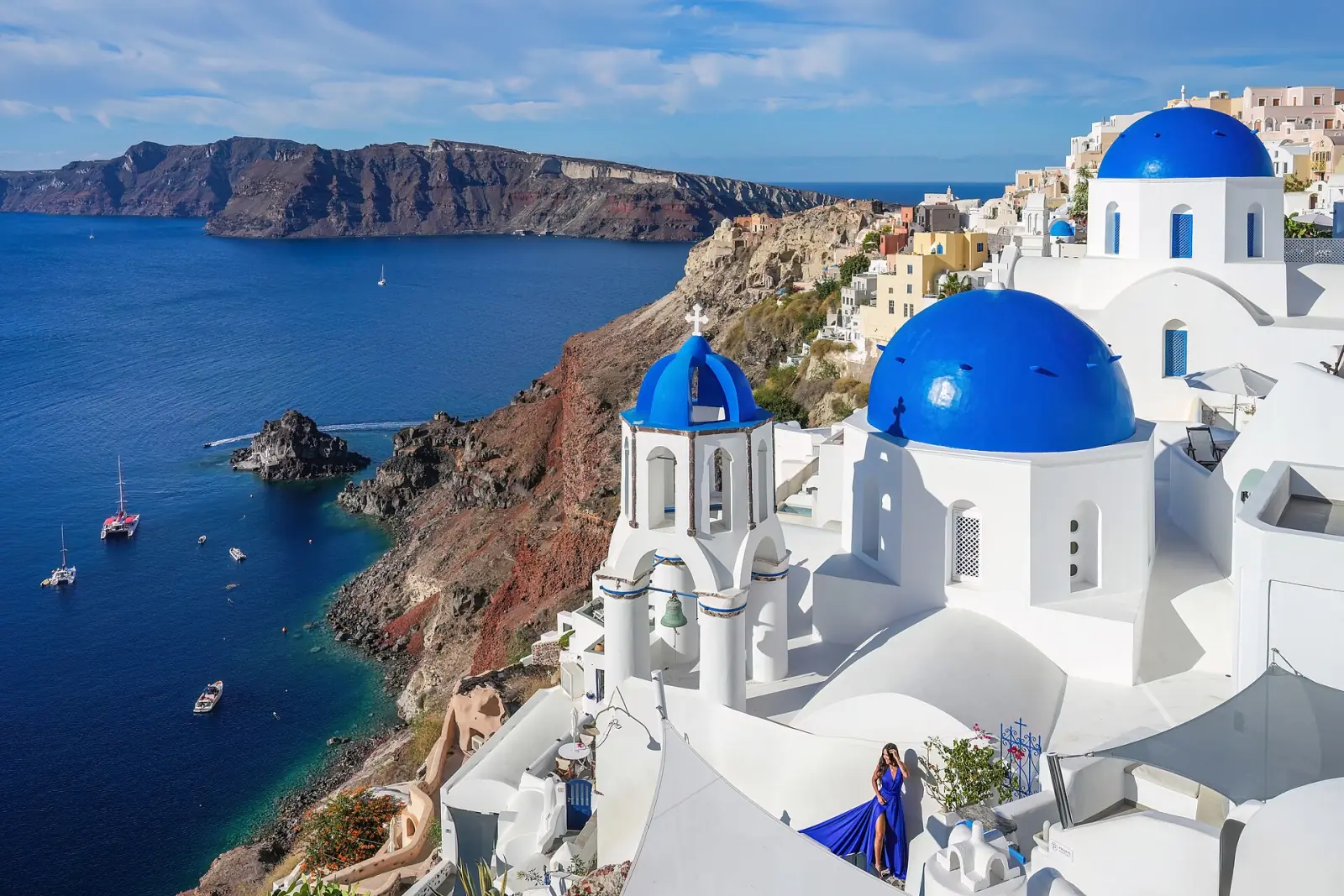
Greece
A solid all-round choice. Ranked 21 of 55, strongest on climate, softest on retiree visa.
- Healthcare 78
- Retiree visa 50
- Affordability 78
- Safety 76
- Climate 88
- Expat community 78
- Retirement visaYesFinancially Independent Person (FIP) national long-stay visa and residence permitglobalcitizensolutions.com
- Min incomeHigh (harder to meet)globalcitizensolutions.com
- Monthly budgetLower than the USnumbeo.com
- HealthcareGoodglobalcitizensolutions.com
- SafetySafecountryeconomy.com
- Top citiesAthens, Crete, Corfu
Good to know
- Good healthcare accessGreece has a universal public healthcare system called ESY (Ethniko Systima Ygeias) providing free or low-cost care to residents. The WHO once ranked Greece 14th globally for overall healthcare performance; quality is high in cities.globalcitizensolutions.com
- Dedicated retirement visaFinancially Independent Person (FIP) national long-stay visa and residence permitglobalcitizensolutions.com
- Low cost of livingCost of living (excluding rent) is about 23% lower than the US; including rent about 36% lower. A single person's estimated monthly costs are around EUR 784 excluding rent, and a family of four around EUR 2,767 excluding rent.numbeo.com
- Safe for retireesGreece ranked 40th of the countries measured in the 2024 Global Peace Index with a score of 1.793, up 17 places, reflecting a peaceful and stable environment.countryeconomy.com
- Comfortable climateThe climate is predominantly Mediterranean, with hot, sunny, dry summers and mild, wet winters where snow rarely lasts. Complex geography gives many micro-climates and local variations.en.wikipedia.org
- Established expat communityGreece is a popular retirement destination with a high English-speaking community; expat retirees concentrate around Athens, Crete, Rhodes, Santorini and Corfu. Greece scores 592 on the EF English Proficiency Index (rank 20, High band).ef.com
Watch out for
No cautions from the verified data.
Visa & residency
Financially Independent Person (FIP) national long-stay visa and residence permit
Minimum passive income of about EUR 3,500 per month for a single applicant, plus roughly 20% (EUR 700) for a spouse and 15% (EUR 525) per dependent child. Over USD 3,000 per month, so a high band.
For US and UK retirees this is the Greek national path, not EU freedom of movement. Enter on a long-stay visa valid up to 12 months, then obtain a temporary residence permit valid three years and renewable. Income must be passive (pension, rental, dividends); the permit does not grant labour market access. Path to permanent residency after five years.
Healthcare
Greece has a universal public healthcare system called ESY (Ethniko Systima Ygeias) providing free or low-cost care to residents. The WHO once ranked Greece 14th globally for overall healthcare performance; quality is high in cities.
Non-EU expats typically need private health insurance; public insurance (EFKA/IKA) does not cover private hospitals, and proof of health insurance is required for residence permits. Private facilities offer newer equipment and shorter waits.
Cost of living
Cost of living (excluding rent) is about 23% lower than the US; including rent about 36% lower. A single person's estimated monthly costs are around EUR 784 excluding rent, and a family of four around EUR 2,767 excluding rent.
Rent is roughly 66% lower than in the US. A one-bedroom city-centre apartment averages about EUR 484 per month and a three-bedroom about EUR 821.
Safety
Greece ranked 40th of the countries measured in the 2024 Global Peace Index with a score of 1.793, up 17 places, reflecting a peaceful and stable environment.
Climate
The climate is predominantly Mediterranean, with hot, sunny, dry summers and mild, wet winters where snow rarely lasts. Complex geography gives many micro-climates and local variations.
Community & language
Greece is a popular retirement destination with a high English-speaking community; expat retirees concentrate around Athens, Crete, Rhodes, Santorini and Corfu. Greece scores 592 on the EF English Proficiency Index (rank 20, High band).
Official language is Greek; English is widely spoken in cities and tourist areas.
Taxes
Greece offers a flat 7% tax on foreign-sourced income, including foreign pensions, for qualifying new tax residents, exhausting the tax liability on that income; it applies for up to 15 years and is paid in one instalment by the last working day of July. Application by 31 March of the tax year.
To use the pensioner regime the retiree must transfer tax residence from a country that has an administrative-cooperation (double taxation) agreement with Greece, and must not have been a Greek tax resident for five of the previous six years. US citizens remain taxed by the US on worldwide income.
Moving & migration
Foreign retirees from non-EU countries need: a valid passport, Greek tax number (AFM - Arithmos Forologikou Mitroou), proof of address in Greece (rental contract or utility bill), and a valid residence permit (or the 'blue certificate' confirming application submitted). EU citizens need passport/ID, AFM, and proof of address. Expat-friendly banks: National Bank of Greece, Alpha Bank, Piraeus Bank, and Eurobank. Physical presence is required. Some banks may allow online pre-application but in-person verification is mandatory. EU residents benefit from the EU Payment Accounts Directive giving right to a basic bank account. Capital controls from the 2015 crisis have been fully lifted, but some restrictions on large international transfers may trigger AML checks.
Greece has a public healthcare system (ESY - Ethniko Systima Ygeias) managed by EOPYY (National Organization for Healthcare Provision). To access it: (1) Obtain an AMKA (social security number) from a local KEP (Citizen Service Center) or EOPYY office -- requires passport, residence permit (or receipt), and AFM. (2) Register with EOPYY to get a 'health booklet' (vivliario ygeias). EU citizens can use the European Health Insurance Card (EHIC) for temporary stays; for permanent residence, register through EOPYY via the S1 form. Non-EU retirees must enroll in the public system or purchase private health insurance. Those on a residence permit for 'financially independent persons' (retirees) must show proof of private health insurance as a condition of the permit. Once legally resident and paying social contributions (if applicable), you gain full access. Practically, many expats use a combination of public hospitals and private clinics. Private health insurance costs approx. EUR 100-300/month for retirees depending on age and coverage.
EU/EEA driving licenses are valid in Greece indefinitely (until expiration date on the license). Non-EU licenses are valid for 185 days (6 months) from the date of entry or from the date of obtaining residence. After this period, you must convert your license: Greece has bilateral agreements with certain countries (USA, Canada, Australia, UK, Switzerland, and several others) allowing direct conversion without tests. If your country has no agreement, you must pass the full Greek driving exam (theory test in Greek, English, or several other languages + practical test). At age 65, licenses must be renewed every 3 years (vs every 15 years for under-65). At age 80, annual medical certification is required. For the conversion process, apply at the regional Directorate of Transport with: original foreign license (with official Greek translation), residence permit, AFM, passport, 4 photos, and medical certificates from a pathologist and ophthalmologist.
EU citizens moving household goods to Greece benefit from free movement of goods within the EU -- no customs duties, simply transport the goods. Non-EU citizens: you can import used household goods and personal effects duty-free under the 'transfer of normal residence' provision if you have a valid residence permit (or are in the process of obtaining one). The goods must have been owned and used for at least 6 months before the move and must arrive within 12 months of establishing residence. Required documents: detailed inventory list (in Greek or English), copy of passport, residence permit or visa, certificate of change of residence from the Greek consulate in country of origin, bill of lading, and a declaration that goods will not be sold for 12 months. Prohibited/restricted: weapons, drugs, counterfeit goods, certain food items. Motor vehicles may be imported duty-free if you have lived outside the EU for at least 12 consecutive months. Typical cost: shipping a 20ft container from the US costs $4,000-$8,000 USD; from within Europe much less.
Greece follows EU pet travel regulations (Regulation (EU) No 576/2013). Requirements: (1) ISO 11784/11785 microchip (implanted before the rabies vaccine). (2) Valid rabies vaccination -- primary vaccination must be given at least 21 days before travel; booster vaccinations are valid immediately if previous vaccine hasn't expired. (3) For entry from non-listed non-EU countries: a rabies antibody titre test (FAVN) is required, performed at least 30 days after vaccination and at least 3 months before travel. (4) EU pet passport (for EU residents) or an official third-country veterinary health certificate (Annex IV certificate) for non-EU residents. (5) Pets must enter through designated Travellers' Points of Entry (usually international airports with veterinary inspection -- Athens, Thessaloniki, Heraklion). (6) Maximum 5 pets per person (unless for competition/shows). (7) No quarantine for properly documented pets. (8) Dangerous dog breeds: Greece has no national ban, but some breeds (Pit Bull, Rottweiler, Doberman, etc.) may face municipal restrictions. Owners of 'dangerous breeds' must register with the municipality.
For non-EU retirees (Financially Independent Person visa/residence permit): Step 1: Apply for a National D visa at the Greek consulate in your home country. Must prove sufficient financial resources (currently approx. EUR 2,000/month minimum income from pensions, investments, or savings), private health insurance valid in Greece, and accommodation in Greece. Processing: 1-3 months. Step 2: Enter Greece with the D visa (valid 1 year). Immediately upon arrival, apply for AFM (tax number) and open a bank account. Step 3: Apply for the actual residence permit ('Adieia Diamonis' - biometric card) at the Aliens and Immigration Directorate in your region at least 1 month before the visa expires. You receive a 'blue certificate' (vevaiosi) confirming submission, which serves as temporary proof of legal residence. Step 4: Biometrics taken. Processing of the card takes 2-6 months. Step 5: The residence permit is issued for the same duration as the visa (typically 2 years initially for financially independent persons), renewable every 2-3 years if conditions are still met. Step 6: After 5 years of continuous and legal residence, you can apply for 'Long-Term Resident' status (EU permanent residence -- 'epi makron diamonontos'). Step 7: Greek citizenship (naturalization) possible after 7 years of continuous legal residence, requiring Greek language proficiency (B1 level), knowledge of Greek history/culture, and integration into Greek society. Processing for citizenship applications takes 2-4+ years currently.
Popular retirement spots
Where retirees in Greece tend to settle, and the honest reason why. Each note shows its source.
Athens
Greece's capital and largest city, with a hot-summer Mediterranean climate and over 3,400 years of history.
Crete
Greece's largest island, with a hot-summer Mediterranean climate, a long coastline and beaches, and a major tourism economy.
Corfu
Ionian island with a Mediterranean climate and many beaches, and a long-standing British connection since the 19th-century protectorate.
Questions about retiring in Greece
Answered from the verified data on this page. Every answer shows its source; anything we have not confirmed says so plainly rather than guessing.
- Does Greece have a retirement visa?
Yes. Greece offers the Financially Independent Person (FIP) national long-stay visa and residence permit.
globalcitizensolutions.com- Do EU citizens need a visa to retire in Greece?
No. Under EU freedom of movement, EU citizens may live and retire in Greece. You can stay up to three months without registering, then register with the local authorities for longer stays.
europa.eu- How much monthly income do I need to retire in Greece?
As a guide: Minimum passive income of about EUR 3,500 per month for a single applicant, plus roughly 20% (EUR 700) for a spouse and 15% (EUR 525) per dependent child. Over USD 3,000 per month, so a high band. Treat this as indicative and verify the current official figure before you rely on it.
globalcitizensolutions.com- Is healthcare good for expats in Greece?
Healthcare quality is rated good. Greece has a universal public healthcare system called ESY (Ethniko Systima Ygeias) providing free or low-cost care to residents. The WHO once ranked Greece 14th globally for overall healthcare performance; quality is high in cities. On cost: Non-EU expats typically need private health insurance; public insurance (EFKA/IKA) does not cover private hospitals, and proof of health insurance is required for residence permits. Private facilities offer newer equipment and shorter waits.
globalcitizensolutions.com- How expensive is it to retire in Greece?
Lower than the US. A comfortable single-retiree budget is Cost of living (excluding rent) is about 23% lower than the US; including rent about 36% lower. A single person's estimated monthly costs are around EUR 784 excluding rent, and a family of four around EUR 2,767 excluding rent.
numbeo.com- Is Greece safe?
Safe. Greece ranked 40th of the countries measured in the 2024 Global Peace Index with a score of 1.793, up 17 places, reflecting a peaceful and stable environment.
countryeconomy.com- What is the climate like in Greece?
The climate is Mediterranean. The climate is predominantly Mediterranean, with hot, sunny, dry summers and mild, wet winters where snow rarely lasts. Complex geography gives many micro-climates and local variations.
en.wikipedia.org- Where do retirees live in Greece?
Popular retirement spots include Athens, Crete and Corfu.
en.wikipedia.org
Compare Greece with its closest rivals
The three countries whose RetireScore sits nearest.